
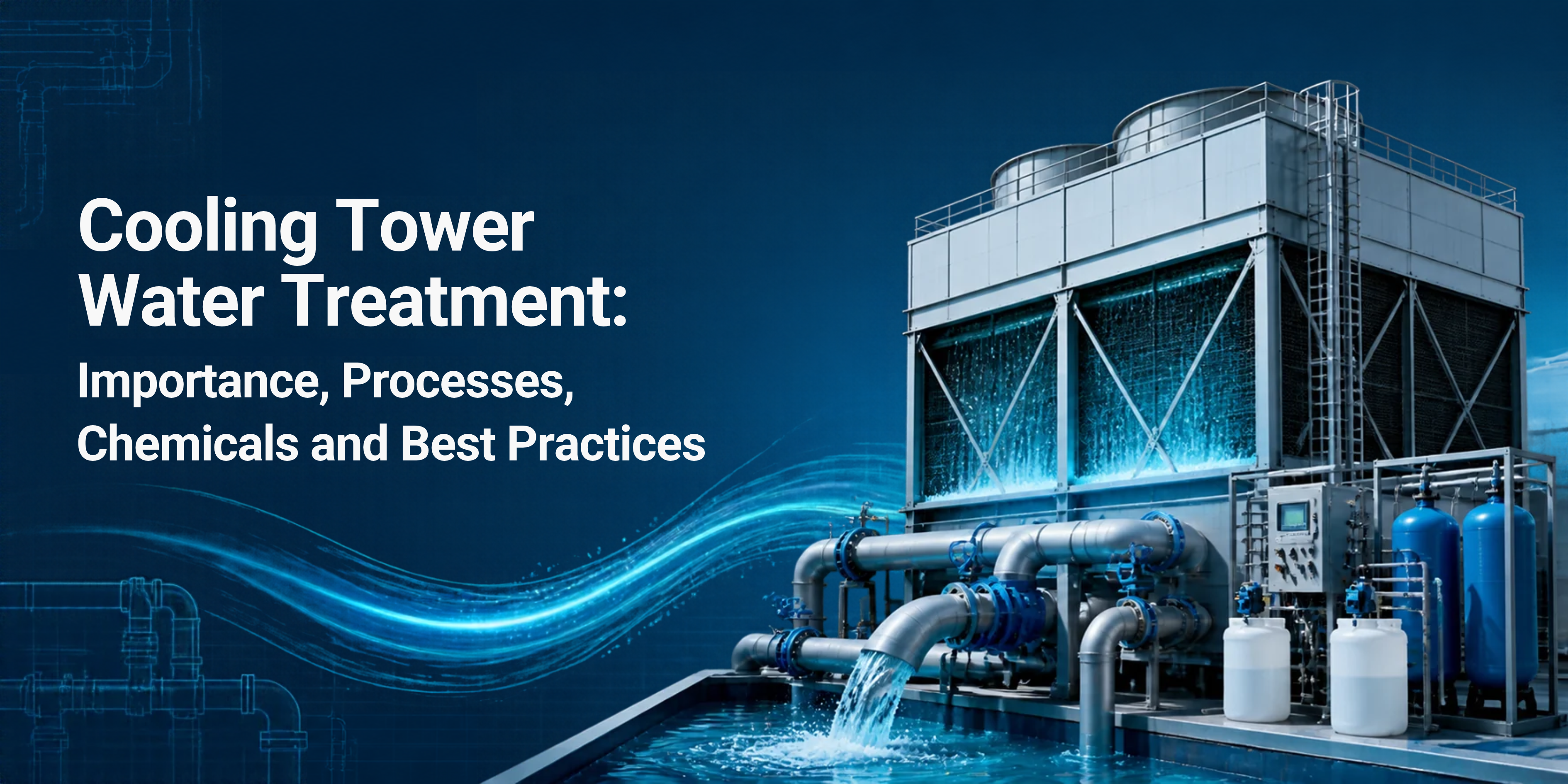
Cooling Tower Water Treatment: Importance, Processes, Chemicals and Best Practices
Cooling towers play an essential role in industrial operations by removing excess heat from equipment, machinery and process systems. Industries such as petrochemicals, manufacturing, power generation, pharmaceuticals and food processing depend on efficient cooling systems to maintain stable operating conditions and ensure uninterrupted production.
However, the efficiency of a cooling tower depends heavily on the quality of water circulating through the system. Without an effective cooling tower water treatment programme, dissolved minerals, suspended solids and microorganisms can accumulate, leading to scaling, corrosion, biological fouling and reduced heat transfer efficiency.
A well-designed water treatment strategy helps industries maintain equipment performance, minimise maintenance requirements, optimise water consumption and improve the overall reliability of cooling systems.
Why Is Cooling Tower Water Treatment Important?
Most industrial cooling towers operate through evaporation. As warm circulating water comes into contact with air, a portion of the water evaporates, carrying away heat. While evaporation helps cool the remaining water, dissolved minerals and impurities are left behind.
Over time, these substances become increasingly concentrated in the circulating water. If not properly controlled, they can create several operational challenges.
1. Prevention of Scale Formation
Scale develops when dissolved minerals, particularly calcium and magnesium salts, precipitate and form hard deposits on heat exchanger surfaces, pipelines and cooling tower components.
These deposits reduce heat transfer efficiency, restrict water flow and increase energy consumption. Appropriate scale inhibitors and dispersants help control mineral precipitation and minimise deposit formation.
2. Protection Against Corrosion
Cooling water comes into contact with different metals, including carbon steel, stainless steel and copper alloys. Changes in water chemistry, dissolved oxygen, pH and chloride concentration can accelerate corrosion.
Corrosion can damage pipelines, heat exchangers and other critical equipment, potentially resulting in leakage, unplanned shutdowns and expensive repairs. A suitable corrosion inhibitor programme helps protect metal surfaces and extend equipment service life.
3. Control of Microbiological Growth
Warm water, sunlight and nutrients create favourable conditions for microorganisms to grow in cooling towers.
Algae, bacteria and fungi can form deposits and biofilms across cooling tower surfaces and water distribution systems. Regular microbiological monitoring, supported by appropriate biocides and biodispersants, helps maintain hygienic and efficient cooling system operation.
4. Improved Heat Transfer Efficiency
Scale, suspended solids and biological deposits create an insulating layer on heat exchange surfaces. This reduces the system’s ability to transfer heat effectively.
Maintaining clean heat transfer surfaces through appropriate chemical treatment and regular maintenance helps improve cooling performance and reduce unnecessary energy consumption.
5. Optimised Water Consumption
Water is lost from cooling towers through evaporation, drift and blowdown. Industries must continuously replenish these losses with make-up water.
An effective treatment programme allows operators to manage cycles of concentration more efficiently, reduce unnecessary blowdown and optimise freshwater consumption without compromising system safety.
How Does the Cooling Tower Water Treatment Process Work?
An effective cooling tower water treatment programme involves a combination of water-quality assessment, chemical conditioning, monitoring and preventive maintenance.
The treatment strategy should be developed according to the make-up water quality, cooling system design, operating temperature, metallurgy and environmental discharge requirements.
1. Make-Up Water Quality Assessment
The first step is to understand the quality of water entering the cooling tower.
Make-up water can originate from municipal supplies, groundwater, surface water or treated industrial wastewater. Each source has a different chemical composition and may introduce impurities into the cooling system.
Important water-quality parameters include:
- pH and alkalinity
- Total hardness
- Conductivity and total dissolved solids (TDS)
- Chloride and sulphate concentration
- Silica content
- Suspended solids
- Microbiological activity
Analysing these parameters helps identify potential scaling, corrosion and fouling risks and determines whether additional pretreatment is required.
2. Managing Cycles of Concentration and Blowdown
Cycles of concentration indicate how many times dissolved substances are concentrated in circulating water compared with the make-up water.
As evaporation takes place, dissolved salts remain in the cooling system. To prevent excessive accumulation, a portion of the circulating water is discharged through a process known as blowdown.
Fresh make-up water is then added to maintain the required water level and chemistry.
Maintaining appropriate cycles of concentration is important because:
- Higher cycles can reduce freshwater requirements.
- Excessively high cycles may increase scaling and corrosion risks.
- Controlled blowdown helps maintain acceptable dissolved solids levels.
- Conductivity monitoring supports automated blowdown management.
3. Scale and Deposit Control
Mineral deposits can significantly affect cooling tower performance, particularly in systems operating with hard make-up water.
Scale inhibitors and dispersants are commonly used to control mineral precipitation and keep suspended particles dispersed in the circulating water.
The selection of treatment chemicals depends on factors such as water hardness, alkalinity, silica concentration, temperature and operating cycles.
4. Corrosion Control
Corrosion management is another essential component of industrial cooling water treatment.
Corrosion inhibitors help form protective layers on metal surfaces, reducing their exposure to corrosive conditions.
The treatment programme should consider the different metals used throughout the cooling circuit, as each material may respond differently to water chemistry.
5. Microbiological Control
Microbial contamination must be managed continuously to prevent biofilm formation and biological fouling.
Cooling tower treatment programmes commonly use oxidising and non-oxidising biocides, depending on the microbiological conditions and system requirements.
Biodispersants may also be used to loosen accumulated biological deposits and improve the effectiveness of biocides.
Types of Chemicals Used in Cooling Tower Water Treatment
Cooling tower water treatment chemicals are selected to address specific operational challenges. The right combination depends on water quality, system design and operating conditions.
1. Scale Inhibitors
Scale inhibitors help prevent the precipitation and deposition of dissolved minerals on heat transfer surfaces and pipelines. They are particularly useful in systems where hardness, alkalinity and silica concentrations create a risk of mineral scaling.
2. Corrosion Inhibitors
Corrosion inhibitors protect metallic components by reducing corrosion reactions and creating protective films on metal surfaces. Their formulation and application depend on the metallurgy and operating conditions of the cooling system.
3. Oxidising Biocides
Oxidising biocides help control bacteria, algae and other microorganisms in cooling water systems. Their application must be carefully controlled to achieve effective microbiological management while maintaining compatibility with system materials and treatment chemicals.
4. Non-Oxidising Biocides
Non-oxidising biocides provide an alternative approach to controlling microorganisms and may be incorporated into treatment programmes through an appropriate dosing schedule.
5. Dispersants and Biodispersants
Dispersants help keep suspended particles distributed in water, reducing their tendency to settle and accumulate on equipment surfaces. Biodispersants assist in managing biological deposits and improving the performance of microbiological treatment programmes.
6. pH Conditioning Chemicals
pH conditioning chemicals help maintain water chemistry within the operating range required for effective scale and corrosion control. The correct approach depends on water composition, treatment chemistry and system design.
Cooling Tower Maintenance: Best Practices for Industrial Facilities
Chemical treatment alone cannot guarantee reliable cooling tower performance. It must be supported by regular inspection, cleaning and operational monitoring.
Industrial facilities should consider the following maintenance practices:
- Regular Water Quality Testing: Monitor pH, conductivity, hardness, alkalinity, chloride levels and other relevant parameters to identify changes in water chemistry.
- Chemical Dosing Monitoring: Check dosing pumps, chemical storage tanks, feed rates and treatment residuals to ensure consistent chemical application.
- Cooling Tower Cleaning: Periodically inspect and clean basins, cooling tower fills, distribution nozzles, strainers and accessible heat exchange surfaces.
- Corrosion Monitoring: Use suitable monitoring techniques, including corrosion coupons, to assess the effectiveness of corrosion control programmes.
- Microbiological Testing: Monitor microbial activity and maintain appropriate biological control measures.
- Equipment Inspection: Check pumps, pipelines, sensors, conductivity controllers and blowdown arrangements for proper operation.
- Performance Evaluation: Analyse operating trends to identify changes in cooling efficiency, water consumption and chemical usage.
A preventive maintenance programme helps identify potential problems early and reduces the likelihood of unexpected equipment failures.
Water Conservation and Cooling Tower Blowdown Recovery
With increasing pressure on industrial facilities to reduce freshwater consumption and improve environmental performance, water reuse has become an important consideration in cooling tower operations.
Cooling tower blowdown contains concentrated dissolved salts and other impurities removed from the circulating water. Instead of treating this stream only as wastewater, industries can evaluate opportunities for recovery and reuse.
Depending on the quality of the blowdown and the intended application, suitable treatment technologies may include:
- Filtration and clarification
- Chemical conditioning
- Ultrafiltration
- Reverse osmosis
- Advanced membrane treatment
- Evaporation and Zero Liquid Discharge (ZLD) systems
The appropriate treatment combination depends on the characteristics of the blowdown, recovery objectives, discharge requirements and overall plant water balance.
Integrating cooling tower water treatment with wastewater treatment and recycling systems can help industries reduce freshwater intake, minimise wastewater generation and improve resource efficiency.
Choosing the Right Cooling Tower Water Treatment Programme
Every industrial cooling system has different operating requirements. A treatment programme that works effectively in one facility may not deliver the same results in another.
Selecting the right solution requires an understanding of several factors:
- Source and quality of make-up water
- Cooling tower design and operating capacity
- Water circulation rate and evaporation losses
- Cycles of concentration
- System metallurgy and heat load
- Scaling, corrosion and microbiological risks
- Chemical compatibility and discharge regulations
- Water conservation and reuse objectives
A customised treatment strategy combines suitable chemicals, consistent monitoring and preventive maintenance to deliver long-term operational benefits.
Industries should work with experienced water treatment specialists who can evaluate the complete cooling circuit and recommend appropriate treatment solutions.
MAPRIL: Supporting Efficient Industrial Cooling Water Management
MAPRIL, backed by Ion Exchange’s expertise in water and environmental management, supports industrial facilities with solutions designed to improve water quality, operational efficiency and resource utilisation.
Cooling water treatment is an important part of a comprehensive industrial water management strategy. Effective chemical treatment helps control scaling, corrosion and microbiological growth while supporting reliable heat transfer and equipment performance.
MAPRIL’s portfolio includes specialty water treatment chemical programmes, including solutions for cooling water and other industrial utility applications.
Beyond chemical treatment, an integrated approach to water management can also address make-up water quality, wastewater treatment, recycling and recovery requirements.
By combining appropriate treatment technologies, specialty chemicals and technical support, industrial facilities can work towards more reliable operations, optimised water consumption and improved environmental performance.
Explore MAPRIL’s industrial water treatment solutions to identify the right approach for your cooling water management requirements.
Conclusion
Efficient cooling tower operation requires more than maintaining water circulation. It depends on a well-managed water treatment programme that addresses scaling, corrosion, microbiological growth and water consumption together.
By combining appropriate chemical treatment, routine monitoring, preventive maintenance and water recovery strategies, industries can improve cooling efficiency, protect critical equipment and achieve more sustainable water management.
MAPRIL’s industrial water and specialty chemical solutions support facilities in developing effective water treatment strategies tailored to their operational requirements.