
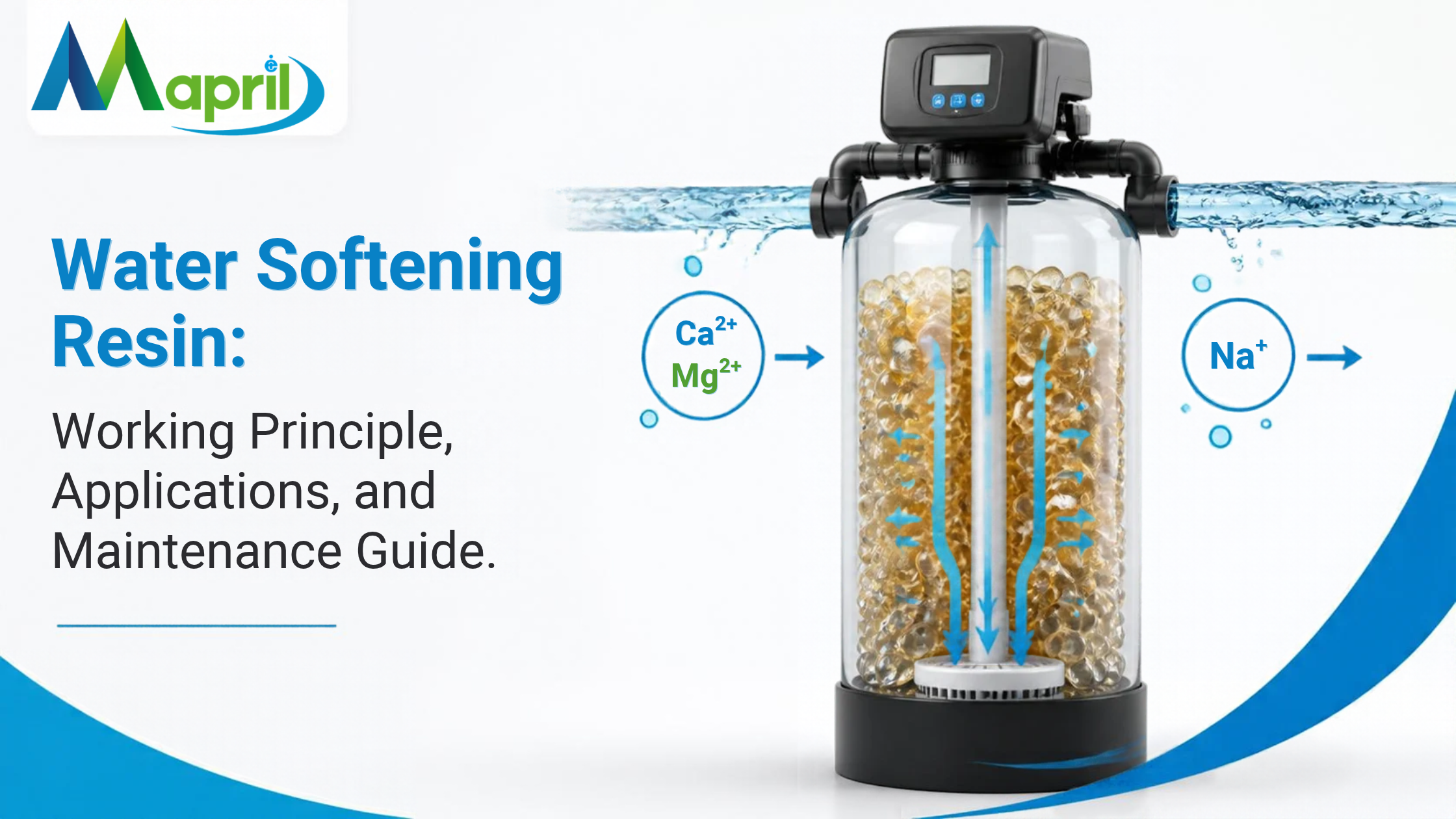
Water Softening Resin: Working Principle, Applications, and Maintenance Guide
Hard water is a common challenge across residential, commercial, and industrial applications. High concentrations of calcium and magnesium in water can lead to scale formation, reduced heat transfer efficiency, increased maintenance requirements, and operational problems in industrial equipment. Water softening resin offers an effective solution by removing hardness-causing minerals through an ion exchange process.
In industrial water treatment systems, selecting the appropriate resin and maintaining its performance are essential for achieving consistent water quality. Understanding how water softening resin works, where it is used, and how it should be maintained can help industries improve operational efficiency and extend equipment life.
What Is Water Softening Resin?
Water softening resin is a specialised ion exchange material used to remove dissolved calcium and magnesium ions from hard water. These minerals are primarily responsible for hardness and can form deposits on pipes, boilers, heat exchangers, cooling systems, and other water-contact surfaces.
The resin generally consists of small polymer beads containing functional groups that exchange ions with the surrounding water. In conventional sodium-cycle water softeners, the resin captures calcium and magnesium ions and releases sodium ions into the treated water.
Water softening resin is widely used in industrial water treatment plants, commercial facilities, manufacturing units, and applications where controlling water hardness is important for process efficiency.
How Does Water Softening Resin Work?
Water softening resin operates through the principle of ion exchange. As hard water flows through a vessel containing resin beads, calcium and magnesium ions are attracted to the resin’s exchange sites. Sodium ions are released in exchange, reducing the hardness of the treated water.
The water softening process typically involves the following steps:
- Water inlet: Hard water enters the softener vessel and passes through the resin bed.
- Ion exchange: The resin captures calcium and magnesium ions while releasing sodium ions.
- Softened water outlet: Water with reduced hardness exits the vessel for use in the intended application.
- Resin exhaustion: Over time, the resin’s available exchange capacity decreases as hardness ions accumulate.
- Regeneration: A concentrated sodium chloride solution is passed through the resin to remove accumulated hardness ions and restore the resin to its sodium form.
Regeneration allows the resin to be reused for multiple treatment cycles. However, the effectiveness of the process depends on resin selection, water quality, operating conditions, and proper regeneration practices.
Types of Water Softening Resin
Different ion exchange resins are available for water treatment applications. The appropriate choice depends on the water chemistry, required treatment capacity, operating conditions, and desired performance.
1. Strong Acid Cation Exchange Resin
Strong acid cation exchange resin is commonly used in conventional water softeners. When supplied in sodium form, it removes calcium and magnesium ions from water through ion exchange.
These resins are widely used in industrial water softening systems, boiler feedwater pretreatment, and applications where reducing hardness helps minimise scale formation.
2. Gel-Type Cation Exchange Resin
Gel-type resins have a cross-linked polymer structure and are commonly used in standard water softening applications. Their performance depends on factors such as cross-linking, bead integrity, water composition, and operating conditions.
3. Macroporous Cation Exchange Resin
Macroporous resins contain a more developed pore structure than conventional gel-type resins. Depending on the resin chemistry and application, this structure can offer advantages in certain demanding operating environments.
Resin selection should be based on the manufacturer’s technical specifications and the actual requirements of the water treatment system rather than resin type alone.
Industrial Applications of Water Softening Resin
Water softening resin plays an important role in industrial water treatment by reducing hardness and helping prevent scale-related operating problems. Some of its major applications include:
1. Boiler Feedwater Treatment
Hardness minerals can form scale on boiler surfaces, reducing heat transfer and increasing energy consumption. Water softeners are commonly used as part of boiler feedwater pretreatment to reduce the risk of hardness-related deposits.
2. Cooling Water Systems
Scale formation in cooling equipment can affect heat transfer performance and increase maintenance requirements. Softened water may be used where hardness control is required by the system’s water treatment programme.
3. Manufacturing Industries
Manufacturing processes often require consistent water quality to maintain product quality and equipment reliability. Water softening systems help control hardness in industries such as textiles, chemicals, food processing, and general manufacturing, depending on process requirements.
4. Commercial Water Treatment
Hotels, hospitals, commercial buildings, laundries, and other facilities may use water softeners to reduce mineral scaling in plumbing, water heating equipment, and selected process applications.
5. Pretreatment for Advanced Water Treatment Systems
Water softening can be incorporated into a larger treatment process before reverse osmosis or other specialised systems when the feedwater chemistry and system design justify it. Appropriate pretreatment helps manage hardness-related scaling risks and supports reliable operation.
Factors Affecting Water Softening Resin Performance
The performance and service life of water softening resin depend on several operating and water quality factors. Understanding these factors helps operators maintain treatment efficiency and avoid unnecessary resin replacement.
Feedwater Quality
High hardness levels increase the demand on the resin’s exchange capacity. Iron, suspended particles, organic matter, and other contaminants may foul or obstruct the resin bed if they are not adequately controlled through pretreatment.
Regeneration Efficiency
Insufficient regenerant dosage, incorrect brine concentration, unsuitable flow rates, or inadequate rinsing can reduce the amount of usable capacity restored during regeneration. Following the resin manufacturer’s operating guidelines is essential for consistent results.
Operating Conditions
Flow rate, pressure, temperature, bed depth, and hydraulic distribution can influence treatment performance. Poor flow distribution or channeling may allow some water to bypass effective contact with the resin, resulting in reduced softening efficiency.
Resin Fouling and Physical Degradation
Contamination and repeated operating cycles can affect resin performance. Oxidising agents, certain metals, organic substances, and mechanical stress may contribute to deterioration depending on the resin’s chemistry and exposure conditions.
Signs That Water Softening Resin Requires Attention
A decline in softener performance does not always mean the resin needs immediate replacement. However, certain warning signs indicate that the system should be inspected.
- Increasing outlet hardness: Hardness begins appearing in treated water earlier than expected during the service cycle.
- More frequent regeneration: The softener produces less treated water between regeneration cycles.
- Inconsistent water quality: The system fails to achieve the required hardness level despite appropriate operating conditions.
- Increasing pressure drop: The resin bed or internal components may be affected by fouling, accumulated particles, or hydraulic problems.
- Reduced capacity after regeneration: The resin continues to deliver lower performance even after regeneration conditions have been checked and corrected.
These symptoms should be evaluated alongside feedwater hardness, treated-water hardness, flow rates, salt consumption, regeneration settings, and pressure readings before deciding whether resin cleaning, system correction, or replacement is required.
Best Practices for Water Softening Resin Maintenance
Proper maintenance can help preserve resin performance, improve operational consistency, and reduce avoidable treatment costs. Industrial operators should consider the following practices:
- Monitor water hardness: Regularly measure inlet and outlet hardness to identify performance changes before they affect downstream equipment.
- Optimise regeneration: Follow the recommended salt dosage, brine concentration, contact time, and rinse procedure for the selected resin.
- Control feedwater contaminants: Use suitable pretreatment where necessary to limit suspended solids, iron, and other substances that may foul the resin.
- Inspect system components: Check distributors, collectors, valves, and flow controls for blockages, leakage, or uneven water distribution.
- Track operating data: Record throughput per cycle, regeneration frequency, salt consumption, and pressure drop to identify performance trends.
- Assess resin condition: Where performance remains poor, consider appropriate resin testing or professional assessment before replacement.
How to Choose the Right Water Softening Resin
Selecting the correct water softening resin is essential for reliable and efficient treatment. A resin suitable for one application may not provide the same performance under different water chemistry or operating conditions.
Before selecting a resin, consider the following factors:
- Feedwater characteristics: Evaluate hardness concentration, iron content, dissolved solids, and other relevant water quality parameters.
- Required treatment capacity: Determine the volume of water to be treated between regeneration cycles and the desired outlet hardness.
- Operating conditions: Review service flow rate, temperature, pressure, vessel dimensions, and hydraulic requirements.
- Regeneration requirements: Assess salt consumption, regeneration frequency, rinse water requirements, and operating costs.
- Application requirements: Consider the requirements of boilers, cooling systems, manufacturing processes, or other downstream equipment.
- Technical support: Consult resin technical data sheets and qualified water treatment specialists to confirm compatibility and operating recommendations.
A properly selected resin, combined with suitable system design and consistent maintenance, can help improve water treatment reliability and minimise hardness-related operational issues.
Conclusion
Water softening resin is an important component of industrial and commercial water treatment systems. By removing calcium and magnesium ions through ion exchange, it helps control water hardness and reduce the risk of scale formation in equipment and pipelines.
Reliable performance depends on more than selecting a resin with the right specifications. Feedwater quality, regeneration efficiency, hydraulic conditions, and regular monitoring all contribute to the effectiveness of a water softening system.
For industries seeking consistent water quality and dependable system performance, understanding resin selection and maintenance is an important step towards optimising water treatment operations.
Looking for suitable water treatment solutions for your application? Contact Mapril to discuss your water quality requirements and explore solutions aligned with your industrial process needs.