
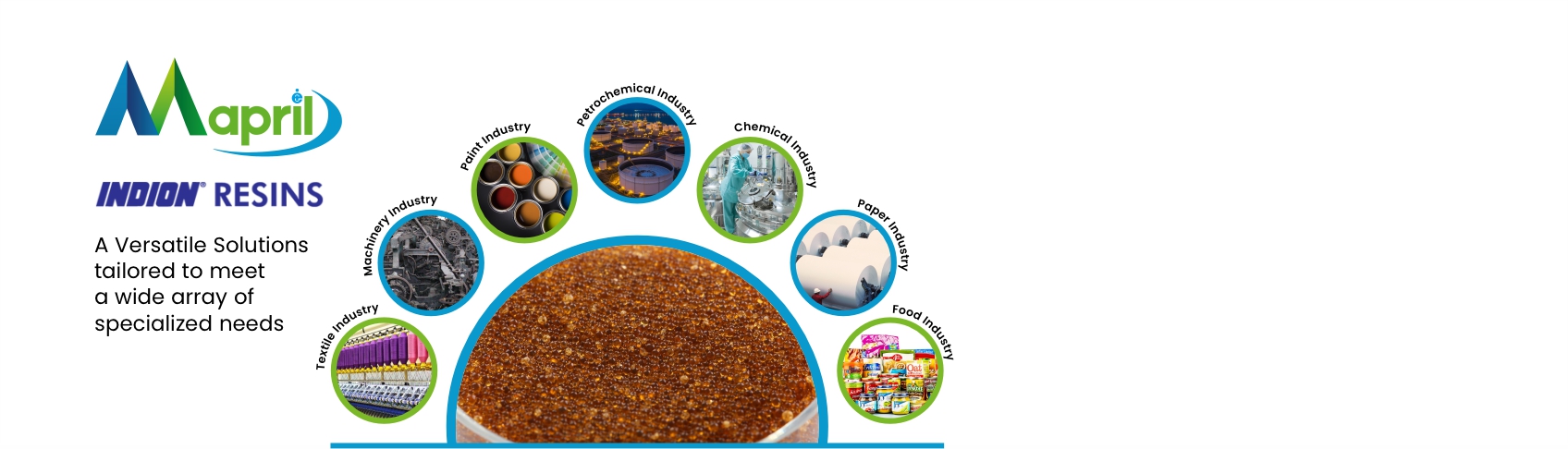
Understanding Resins & Their Industrial Power — A Mapril Perspective
In today’s world of tight regulations, water scarcity, and ever-increasing purity demands, resins are quietly doing heavy lifting across industries. At Mapril, backed by the legacy and technical excellence of the INDION family of ion exchange resins, we believe a clear understanding of resin types is crucial for making the right choices. Let’s dive into what resins are, how ion exchange resins are classified, and how different resin types fuel key industrial applications.
What Are Resins — The Basics
Resins, in the industrial context, usually refer to synthetic polymer matrices engineered to perform specific chemical or physical tasks. Among these, ion exchange resins are perhaps the most ubiquitous in water treatment, separation, purification, catalysis, and specialty processing.
These resins are composed of a cross-linked polymer “backbone” (often a styrene–divinylbenzene matrix) whose surface and internal structure is functionalized with charged groups. Because of their porosity and internal surface area, ions in contact solutions can exchange places with counter-ions bound on the resin — all without degrading the polymer itself. (For background, see the “ion exchange resin” overview.)
Beyond ion exchange, resins more broadly include thermoplastics (e.g. polyethylene, polystyrene, PVC) and thermosetting resins (e.g. epoxy, phenolic) — used in coatings, structural parts, adhesives, composites, and more. But in this blog, we’ll focus on ion exchange resins and their industrial roles.
Classification of Ion Exchange Resins
Ion exchange resins can be classified along several axes. Understanding these distinctions is key to selecting the right resin for your application.
1. Based on Ionic Functionality (What They Exchange)
● Cation Exchange Resins
These resins exchange positively charged ions (cations). For example, they can replace
Ca²⁺ or Mg²⁺ in water with Na⁺ or H⁺.
o Strong Acid Cation (SAC): Uses sulfonic acid functional groups (–SO₃H). These remain fully ionized across a wide pH range and are ideal for hardness removal, demineralization, and mixed-bed polishing.
o Weak Acid Cation (WAC): Uses carboxylic acid (–COOH) groups. These are only partially ionized, thus useful when you want selective removal (e.g. softening under controlled pH, dealkalization).
● Anion Exchange Resins
These resins exchange negatively charged ions (anions).
o Strong Base Anion (SBA): Usually quaternary ammonium functional groups (–NR₄⁺). They remain ionized over a wide pH range and are effective for removing halides, sulfates, nitrates, and for dealkalization.
o Weak Base Anion (WBA): Uses primary/secondary/tertiary amine groups (–NH₂, –NHR, –NR₂). At higher pH, these groups lose charge, making weak-base resins good for applications like organic removal, deacidification, or partial anion control.
2. Based on Physical Structure / Porosity
● Gel (Homogeneous) Resins
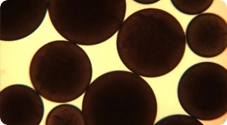
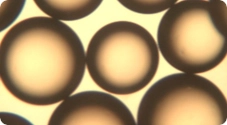
The polymer network is relatively uniform, with the ionic functional groups distributed evenly throughout the bead. These are often preferred when high purity or minimal leakage is required (e.g. ultrapure water systems).
● Macroporous (or Macroreticular) Resins
These have a network of larger pores (micropores + mesopores + macropores), giving better accessibility to larger molecules (e.g. organics, color bodies). They tend to resist fouling and are more structurally robust.
● Isoporous / Uniform-Pore Resins
These are engineered to have a very narrow pore size distribution — helping control diffusion kinetics and selectivity. (Mapril / INDION offers Gaussian and uniform particle size beads with tuned surface area, porosity and matrix.
3. Specialty & Hybrid Resins / Chelating Resins
Some resins are modified further — for instance, chelating resins with groups like iminodiacetate, phosphonic acid, thiol — to selectively bind transition metals, rare earths, or specific contaminants (e.g. arsenic, iron, heavy metals).
Types of Softener Resins (for Water Softening)
When someone speaks of “softener resin,” they typically refer to strong acid cation (SAC) resins in the sodium form. But even within that category, variations exist:
● Gel-type SAC softeners — conventional, widely used for hardness removal in municipal
and industrial water softeners.
● Macroporous SAC softeners — more robust, better resistance to fouling by organics or
colloids, potentially longer life in tougher water matrices.
● High-capacity SAC resins — tailored to carry more exchange sites or enhanced kinetics
for faster regeneration and higher throughput.
Mapril (via INDION) offers softening resins such as INDION 222 Na F, INDION 222 Na BL, INDION 225 Na F etc., used in potable water, industrial softening streams, and blended systems.
Industrial Applications of Resin Types
Resins find application across many sectors. Below is a non-exhaustive but representative list of where different resin types shine, and where Mapril / INDION resins are leveraged.
1. Water & Wastewater Treatment
● Softening & Demineralization
SAC and SBA resins are combined in series (cation + anion) or in mixed beds to remove all ionic species, producing demineralized water for boilers, cooling systems, and specialty processes (semiconductors, pharma).
● Mixed-bed Polishing
In high-purity water systems, a mixed bed (cation + anion resin in one vessel) polishes residual conductivity to ultra-low levels (e.g. in semiconductor, power plant, pharmaceutical industries).
● Regeneration / Ion Exchange Processes
After exhaustion, resins are regenerated (e.g. NaCl for SAC, NaOH for SBA). Proper regeneration, backwash, and control are key to long service life.
● Effluent Treatment & Ion Removal
Specialty or chelating resins may selectively remove nitrate, arsenic, heavy metals, color bodies, or organics (e.g. dyes). Mapril / INDION provides “resins for non-water based” and “speciality resins” for such applications.
2. Chemical & Petrochemical Processing
● Acid / Base Purification
Ion exchange resins are used to purify acids and bases, to remove trace ions, neutralize wastes, or recover expensive ionic species.
● Catalysis & Synthetic Reactions
Some resins act as solid acid catalysts (e.g. sulfonated polystyrene) or as supports for catalytically active species.
● Brine / Chlor-alkali Applications
Ion exchange resins are integral in dechlorination or brine purification units (e.g. in chlorine / caustic production). (In chlor-alkali, specialized resins stable at higher temperatures may be used.)
3. Food & Beverage / Sugar / Bioprocessing
● Decolorization & Purification
After extraction, juices, syrups, or fermentation broths often contain color, phenolics, or charged impurities. Resins can adsorb or ion-exchange these, improving clarity, stability, and taste.
● Ion Removal / Nutrient Control
Removal of ionic contaminants (e.g. nitrates, metal ions) in beverage processing, or control of ionic strength in formulations.
4. Power Plants / Steam Cycles
● Boiler Feed Water Treatment
Demineralized water prevents scale and corrosion in boilers. Mixed-bed resins polish conductivity before steam cycle makeup.
● Condensate Polishing
After steam condenses, residual ionic contamination (e.g. anionic species, copper, iron) is removed by polishing resins to protect turbine and system integrity (examples:
INDION MB-11, MB-12, MB-115 are used for condensate polishing).
5. Nuclear & Specialty High-Purity Applications
Resins used in nuclear or semiconductor applications must meet extremely stringent purity standards (low leachables, stable mechanical integrity, radiation resistance). Mapril / INDION offers nuclear-grade and pharma-grade resins under its portfolio.
6. Hydrometallurgy & Resource Recovery
Chelating or ion-specific resins are used to recover valuable metals (e.g. copper, nickel, uranium), purify streams from leachates, or remove trace contaminants in mined solutions.
Why Choose Mapril / INDION Resins?
Because resin performance is not just about chemistry — it’s about precision engineering, testing consistency, support, and custom tailoring.
● Tailored Particle & Porosity Profiles
Mapril / INDION offers both Gaussian and uniform particle size beads with control over porosity, matrix rigidity, and surface area to match specific application needs.
● Certification & Quality Standards
The resin manufacturing facility (Ankleshwar, India) is ISO 9001 & ISO 14001 certified, and produces pharmaceutical-grade resins with USFDA / WHO-GMP compliance.
● Wide Portfolio
From water-based resins (softening, demineralization, polisher) to non-water-based / specialty resins (catalyst, adsorbent, hydrometallurgy) — Mapril covers the spectrum.
● Global Backing & Local Presence
Mapril (Portugal) is integrated with Ion Exchange’s broader network and resources.
● Custom & Specialty Solutions
For difficult waters, industrial effluents, or niche chemical processes, Mapril can co-develop resins or resin systems tailored to your feed, regeneration constraints, or downstream purity.
Conclusion
Resins may appear as small beads inside vessels — but their impact on process efficiency, water quality, energy usage, and product purity is outsized. Choosing the right resin type (strong vs weak, cation vs anion, gel vs macroporous) is a key decision. With Mapril (powered by the INDION legacy), you get not just high-quality resin products, but the technical support, customization flexibility, and global expertise to solve your toughest ion exchange challenges.